This is the strangest review I have written, because my opinion of this model completely changed halfway through testing it, and the model had nothing to do with it.
I got access to GPT-5.6 on May 27. For about two weeks, I was utterly blown away. I ran it morning, noon, and night. At one point I had so many goal-mode runs going in parallel that I had used 3x the monthly tokens of OpenAI's highest user in 17 days, on one machine. I was building things I did not think models could build, and I was barely typing.
Then Fable came out, I got access, and I stopped using GPT-5.6 almost immediately.
You should know where I am coming from here. If you have read my previous reviews, you know I am usually a GPT person. I do not do much frontend or UX work. I mostly do backend, systems, and agentic work, and GPT models have historically just been better for me there. They tend to nail the change I asked for and nothing else. So when I tell you a Claude model made me abandon a GPT model I loved, understand that this is against type.
Let me explain both halves: why GPT-5.6 blew me away, and why I barely use it now.
Goal Mode Is Pure Sorcery
Goal mode is simple to describe. You type /goal in the Codex CLI or app, you give it an objective with clear completion criteria, and the model does not stop until the goal is done. When a run finishes, goal mode checks whether the goal is actually met. If it is not, it starts a new run and keeps going. On repeat. For days if it has to.
If you read my Fable prompting guide, everything in it applies directly here, because I developed a lot of those techniques on GPT-5.6 first. Make "done" a test, not an adjective. Never let it finish. Make builders and judges separate agents. Have it keep a progress page you can check from your phone. GPT-5.6 responds to all of it.
Two tricks specific to goal mode:
- Goals are capped at 4,000 characters. Do not fight the limit and try to cram stuff in... instead write the real goal as a markdown file and make the goal itself one line: "Complete the objective and completion criteria in goal.md. Treat this file as the durable source of truth throughout the run." As a bonus, you can edit the file while the run is going.
- Spend a long time on that goal file. Have a model help you write it. The goal file is doing the job a manager would normally do, and every ambiguity you leave in it is a decision the model will make without you.
It Built Manhattan
The best way to show you what this looks like is what it built.
I gave it a goal file that said, in essence: build an explorable 3D voxel recreation of Manhattan that looks, sounds, and operates like the real city, including the real New York City subway system. The standard I wrote into the goal was simple: someone who knows New York should be able to tell where they are.
Days later, I had this.

That is the actual island. The skyline matches. The building shapes match. The geography and topography match. It pulled real city data to do it, so the Empire State Building is at 40.7485° N, 73.9868° W, where it belongs.

And the subway works. Not "there is a subway texture." You walk down a real street, find a station entrance at its real location, go underground, board a train on the correct line, ride it through the tunnels, transfer where you would actually transfer, and come out of a real exit somewhere else in the city. It even found a way to match the actual subway schedules of the real Manhattan, so the digital trains were in sync with the real thing.

The destruction game I had it tackle was the same story. The goal: a first-person voxel destruction game that stands up next to Teardown, with real voxels and real structural physics. Blow out a building's base and everything above it collapses under its own weight. That run went five days and more than seventy iterations.
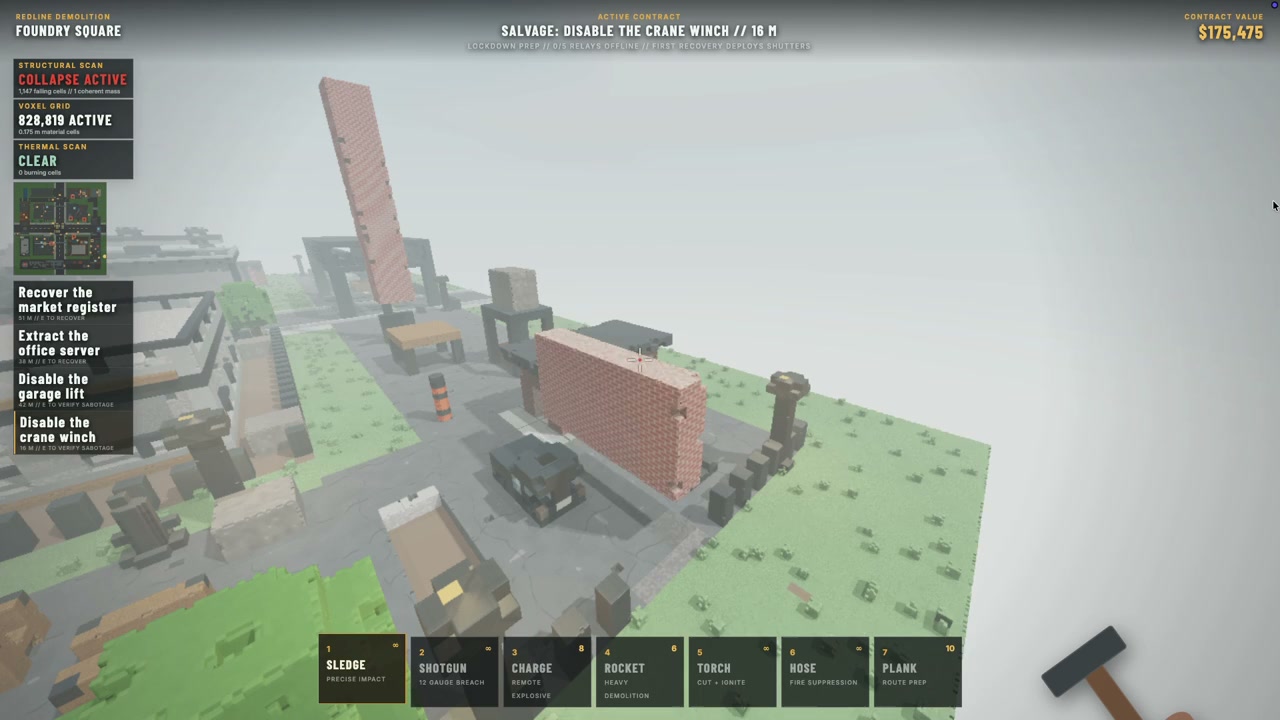
Two things from those runs stuck with me. First, it graded itself honestly. Early in the Manhattan run, its own progress journal refused to count the draft as progress: "visibly not Manhattan and is not accepted as a city milestone." It would not declare victory for days, because the goal file would not let it. Second, it took the judging seriously in ways I never asked for. It spun up hundreds of adversarial reviewer subagents, and found tons of little issues to iron out.
One run even filled my Mac's disk mid-goal, cleaned out the caches it could verify were safe to delete, then installed a cloud sandbox CLI and moved itself there to keep working. Impressive and slightly alarming in the same motion, which is a fair summary of this model.
So yes: for two weeks I thought this was the future.
Then Fable Came Out
Then I got Fable, and the comparison was not close.
I went back and reran some of my GPT-5.6 projects to be fair about it. The clearest test was the programmatic 3D and video work, the same kind of thing behind the worlds I have been posting. GPT-5.6's output was better than any previous GPT model. It was also nowhere near Fable. The results just looked dramatically worse, and no amount of iteration closed the gap.
This has become my new benchmark for models, by the way: have it build a physics-accurate voxel engine from scratch and see how far it can take it. It is a brutal test because there is no library to lean on and no way to fake it. GPT-5.6's engines landed far, far below Fable's bar.
The deeper difference is handholding. With Fable, you say what you want and it gets done. With GPT-5.6, a lot gets done, but the ambitious stuff needs steering. You are correcting course, re-explaining the bar, pushing it to be less conservative. That is still much less babysitting than last generation's models needed. It is much more than Fable needs, which is approximately none.
Trust is the other half of this. With the right guardrails and setup, I do not check Fable's code anymore. I know I can trust it. I still check 5.6's, quite often.
Some of the things I built on GPT-5.6 I never even bothered to retest, because after a few weeks with Fable they felt below the waterline.
Big Model Smell
Here is my honest read on why.
Fable has big model smell. You can just tell you are talking to something enormous. It generalizes. You push it somewhere weird and it is still smart there.
GPT-5.6 feels like a smaller model. Still big, but smaller, with an incredible amount of reinforcement learning on top. And RL gets you exactly what you would expect: the model is extremely good at the shapes of work it was trained on, and benchmarks are the most trained-on shape of all. That is why the scores look close. Then you take one step off the paved road, into a from-scratch voxel engine or a 3D render, and the difference is immediate.
That makes GPT-5.6 a more targeted tool than the benchmarks suggest.
I genuinely hope OpenAI trains a truly big model, because their RL on top of something Fable-sized would be absolutely incredible. That model just does not exist yet (as far as we know... it likely will soon).
Where GPT-5.6 Still Wins
It is not all one-directional, and the exceptions are important to note.
Security. GPT-5.6 is more willing to do cybersecurity work than Fable, which can refuse tasks that pattern-match to dangerous. And it is genuinely good at it. My actual workflow now: Fable writes the code, and GPT-5.6 audits it. Since codex exec runs headless, you can wire this into a hook that audits every commit, or fires after every Fable run finishes.
Limits. OpenAI's limits are much more generous than Anthropic's. This has always been true and it is still true. If you are rationing Fable tokens, GPT-5.6 is a great second option (or you can use it to execute while Fable plans).
The interface. The Codex app is still the best way to run and steer agents, especially from a phone. Pair it once and you can dispatch work, review diffs, and keep goal runs going from anywhere. I use it less than I used to, because I found my own way to do this with Fable: I have it work in a doc on workbench.md, and I can read its updates and steer it right from a chat component in the doc on my phone. But as a product, OpenAI's team remains ahead here, and it is not close.
When to Use What
- If you can use Fable: Fable for pretty much everything. GPT-5.6 for security audits, for a second set of eyes on important changes, and as an implementer executing Fable's plans when you want to save cost.
- If you cannot: GPT-5.6, without hesitation. It is the best model anyone else makes, running it in goal mode is the best agentic setup you can have today, and everything in this review that sounds lukewarm is only lukewarm relative to Fable.
Final Thoughts
If Fable did not exist, this would be the most glowing review I have ever written. A model that can run for days against a goal file, judge its own work adversarially, and ship a working voxel-based Manhattan is not a small thing. Six months ago it would have been science fiction.
But Fable exists. And the honest summary of GPT-5.6 is that second place has never been this good, and it has never mattered this little. The frontier is not a leaderboard where silver is worth something. If one model can do what the other cannot, you use that model, and the gap right now is wide enough that I reorganized my whole workflow around it within days.
GPT-5.6 is an amazing model. I hope OpenAI's next one makes me switch back. They have done it to me before.
Follow @mattshumer_